Ireland Fines Google €403 Million: Retention and Lawful Basis Are Settings, Not Policies
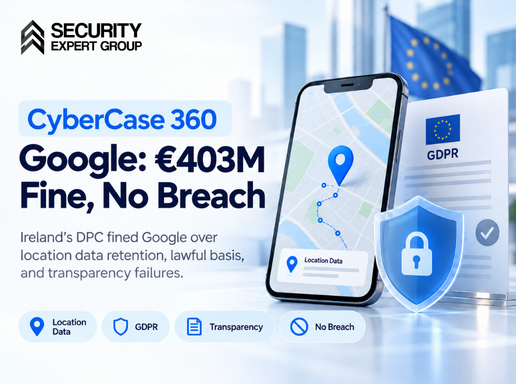
On 21 September 2026, Ireland’s Data Protection Commission announced a €403 million fine against Google Ireland Limited, together with an order to bring its processing into compliance within six months (Data Protection Commission, 21 September 2026). The decision — taken by Commissioners Dr Des Hogan, Mr Dale Sunderland and Ms Niamh Sweeney — concerned three features: Web & App Activity, Location History and Location Accuracy. The European Data Protection Board records the decision as finding infringements of GDPR Articles 5, 6, 12 and 13 (European Data Protection Board, 21 September 2026).
What makes this decision worth a security team’s attention is what it is not. There was no breach, no attacker, no CVE and no incident report. Nobody stole the location data. The finding is that Google processed it unlawfully and unfairly, kept it for longer than was necessary, and described it to users in terms that left them unable to understand that their movements were being used to infer their interests and shape the advertising they saw (Data Protection Commission, 21 September 2026). Every one of those failures is a state of configuration, not a security event — and that is precisely why it transfers to organisations a fraction of Google’s size.
The chronology is the second lesson. Eight European consumer organisations, coordinated by BEUC, filed complaints on 27 November 2018 under the campaign “Every Step You Take,” alleging that consent obtained through Google’s interface was not freely given (BEUC, 27 November 2018). The DPC opened its statutory inquiry on 4 February 2020, pursuant to section 110 of Ireland’s Data Protection Act 2018 and the Article 60 cooperation mechanism (TechCrunch, 4 February 2020). The conduct examined stops on the day the inquiry opened. The penalty arrived six years and ten months after the complaints were filed.
Google’s position is that the case concerns “historical policies” it has since changed, pointing to auto-delete options introduced in 2019 with three-, eighteen- and thirty-six-month settings, device-based storage for Maps Timeline, and simplified ad personalisation controls (Google, via The Irish Times, 21 September 2026). That response is instructive rather than merely defensive: every remedy it describes is a setting. The fine is what a retention control costs when it exists as an intention rather than as an enforced expiry.
For any organisation collecting location, telemetry or behavioural data — which now means most organisations with a mobile application or an analytics stack — the transferable finding is narrow and uncomfortable. You will not be judged on your privacy notice. You will be judged on whether the storage layer actually deletes, whether every collection path carries a recorded purpose and lawful basis, and whether you can evidence both for processing you switched off years ago.
1. What Happened
| 1. On 21 September 2026, Ireland’s Data Protection Commission fined Google Ireland Limited €403 million following an inquiry into the company’s processing of location data (Data Protection Commission, 21 September 2026). |
| 2. The inquiry covered three features — Web & App Activity, Location History and Location Accuracy — over the period 25 May 2018 to 4 February 2020 (Data Protection Commission, 21 September 2026). |
| 3. The DPC found that Google’s processing of location data in Web & App Activity and Location History was unlawful and unfair, and that Google retained that location data for longer than was necessary (Data Protection Commission, 21 September 2026). |
| 4. For Location Accuracy, the DPC found that Google failed to demonstrate compliance with the lawfulness, fairness and transparency principle; it found transparency failures across all three features (Data Protection Commission, 21 September 2026). |
| 5. The European Data Protection Board records the decision as finding infringements of GDPR Articles 5, 6, 12 and 13 (European Data Protection Board, 21 September 2026). |
| 6. Google was ordered to bring its processing into compliance within six months of the decision (Data Protection Commission, 21 September 2026). |
| 7. The inquiry was an own-volition inquiry opened on 4 February 2020, with the DPC acting as Lead Supervisory Authority under section 110 of the Data Protection Act 2018 and the Article 60 cooperation mechanism (TechCrunch, 4 February 2020). |
| 8. The complaints behind it were filed on 27 November 2018 by eight European consumer organisations coordinated by BEUC, including Forbrukerrådet (Norway), Consumentenbond (Netherlands) and Sveriges Konsumenter (Sweden) (BEUC, 27 November 2018). |
| 9. Deputy Commissioner Graham Doyle stated that Google’s failures meant individuals “could be unaware that their location was being used to, for example, influence them with ads or to infer their interests, and could lose control over their personal data” (Data Protection Commission, via The Irish Times, 21 September 2026). |
2. Business Impact
| [CONFIRMED] €403,000,000 administrative fine imposed on Google Ireland Limited (Data Protection Commission, 21 September 2026; corroborated by European Data Protection Board, 21 September 2026). |
| [CONFIRMED] Order to bring processing into compliance within six months of the decision — an engineering deadline, not a payment deadline (Data Protection Commission, 21 September 2026). |
| [CONFIRMED] Infringements found against GDPR Articles 5, 6, 12 and 13 (European Data Protection Board, 21 September 2026). |
| [CONFIRMED] Six years and ten months elapsed between the BEUC complaints and the decision — arithmetic on two dated primary sources: complaints filed 27 November 2018 (BEUC) and decision announced 21 September 2026 (Data Protection Commission). |
| [CONFIRMED] Reported as the fourth-largest fine issued by the Irish DPC under the GDPR (The Irish Times, 21 September 2026). |
| [CONFIRMED] Google states the decision concerns “historical policies” and points to remediation shipped since 2019 — auto-delete settings of three, eighteen and thirty-six months, device-based storage for Maps Timeline, and simplified ad personalisation controls (Google, via The Irish Times, 21 September 2026). |
| [ESTIMATED] Google may appeal elements of the decision, which would defer finality of both the penalty and the six-month compliance order (The Irish Times, 21 September 2026). Reported as a possibility, not a filed appeal. |
| [CONFIRMED] Number of affected data subjects: scale not publicly disclosed. The DPC announcement contains no record count, and none appears in this briefing because none has been published. |
3. Likely Root Cause
| Retention was governed by policy rather than enforced by the storage layer — location data in Web & App Activity and Location History was kept for longer than was necessary.
Source: Data Protection Commission, 21 September 2026 |
| The lawful basis for each feature could not be demonstrated on the record. The Location Accuracy finding is specifically an accountability failure — an inability to show compliance — rather than a finding that the collection itself was unlawful.
Source: Data Protection Commission, 21 September 2026 |
| Three features collected overlapping location data under separate settings and separate consent surfaces, so a user’s decision in one place did not necessarily govern collection in another.
Assessed from the DPC’s per-feature findings, 21 September 2026 |
| Notices described collection but not inference — users were not brought to understand that location would be used to derive their interests and target advertising.
Source: Data Protection Commission via The Irish Times, 21 September 2026 |
| The interface was alleged by the original complainants to steer users into enabling tracking, such that consent was not freely given. [UNRESOLVED] This is a 2018 complainant allegation; it is not a finding reproduced in the DPC’s public announcement, and the full decision text was not published alongside it.
Source: BEUC, 27 November 2018 — complainant allegation, unconfirmed against the decision |
4. Control Failures
| [CF-1] 📋 PROCESS
Retention periods defined as policy but not enforced as an expiry anywhere in the storage path, so “longer than necessary” was the default outcome rather than an exception. |
| [CF-2] 📋 PROCESS
No demonstrable lawful-basis record bound to each processing purpose, leaving accountability unprovable years after the processing had stopped. |
| [CF-3] ⚙️ TECHNOLOGY
Multiple features collecting overlapping location data through separate, un-reconciled collection paths, with no single instrumented inventory of where location entered the estate. |
| [CF-4] 🔗 THIRD PARTY
Location data and inferred interests flowing onward into advertising and analytics processing without purpose limitation enforced at the point of transfer. |
| [CF-5] 👥 PEOPLE
Users unable to understand from the notice what was collected, or that it would be used to infer their interests — so any consent rested on an invalid basis. |
5. Recommendations
5A. Organisational & Technical Controls
Audience: security, IT and data-engineering teams.
| ↳ CF-1 Enforce retention as a storage-layer expiry, not a policy statement
GDPR Art. 5(1)(e) — storage limitation; ISO/IEC 27001:2022 Annex A 8.10 — information deletion Set the retention ceiling where the data physically lives: object-lifecycle expiration on every bucket holding location events (S3 Lifecycle Expiration, GCS Object Lifecycle Delete-by-age, Azure Blob lifecycle delete action), partition expiry in the warehouse (partition_expiration_days on BigQuery tables, DATA_RETENTION_TIME_IN_DAYS on Snowflake), and a finite retention.ms on every Kafka topic carrying coordinates — never the broker default. Retain the deletion job’s output as the audit artefact: a retention control that leaves no evidence of having run cannot discharge Art. 5(2). |
| ↳ CF-2 Bind a machine-readable purpose and lawful basis to every field carrying personal data
GDPR Art. 5(2) and Art. 6(1); NIST SP 800-53 Rev. 5 PT-2 — authority to process PII; PT-3 — PII processing purposes Carry purpose and lawful_basis as mandatory column-level tags in the data catalogue, and fail the build in CI when a job reads a column whose declared purposes do not include that job’s own purpose. A lawful-basis register maintained as a spreadsheet drifts from the estate within one quarter; one that gates deployment cannot. Version the register in the same repository as the schema, so the basis and the field change in a single reviewable commit. |
| ↳ CF-3 Instrument and gate every collection path before it ships
GDPR Art. 25(2) — data protection by default; CIS Controls v8.1 Safeguards 3.1 and 3.2 — data management process and data inventory (Implementation Group 1) Treat location permissions as a release gate rather than a code-review preference: block ACCESS_FINE_LOCATION and ACCESS_BACKGROUND_LOCATION on Android, and NSLocationAlwaysAndWhenInUseUsageDescription on iOS, unless the manifest diff carries a named purpose and a named approver. Maintain an SDK allowlist in the build and diff the application’s outbound hosts every release — a third-party SDK added for analytics is a new collection path whether or not anyone recorded it as one. |
| ↳ CF-4 Enforce purpose limitation at the point of transfer, not downstream
GDPR Art. 5(1)(b) — purpose limitation; Art. 28(3) — processor instructions; ISO/IEC 27701:2019 — PIMS controller controls Evaluate consent state at SDK initialisation so that a refusal means the location API is never called, rather than the event being discarded after collection — in tag-managed stacks, ad_storage, ad_user_data and ad_personalization default to denied before any tag fires. Write a named retention ceiling and an audit right into every processor agreement, then verify it by requesting the processor’s deletion log rather than its retention policy. |
| ↳ CF-5 Generate the privacy notice from the same metadata that gates the pipeline
GDPR Art. 12(1) — transparent information; Art. 13(1)(c) — purposes of processing The notice and the catalogue should be one artefact rendered twice, so a new purpose cannot reach production without appearing in the notice. State inference explicitly — that location is used to derive interests and to target advertising — because the DPC’s finding was that users did not understand this, not that it was wholly undisclosed. Deliver the user-facing rules in 5B below as a standing briefing to product, marketing and engineering. |
5B. For the Product and Marketing Team
| 📋 READY-TO-FORWARD ONE-PAGER
Audience: the people whose everyday decisions create the collection paths — no technical knowledge assumed. ↳ CF-5 GDPR Art. 5(1)(a) and 5(1)(e) — lawfulness, fairness, transparency and storage limitation; ISO/IEC 27001:2022 Annex A 6.3 — information security awareness, education and training. 1. Write down why you are collecting it, before you collect it. If you cannot say in one sentence what a piece of data is for, you do not have a reason to collect it — you have a hope that it will be useful later. That hope is not a legal basis. A regulator may ask you for that sentence years after you have forgotten the feature existed. 2. Ask for an end date, not just a start date. Every request to collect something new should arrive with the date it gets deleted. If the answer is “keep it forever,” the answer is wrong. Put the deletion date in the ticket, the same way you would put in a launch date. 3. Say what you actually do with it, in words a customer would use. “We use your location to work out what you are interested in and to choose which ads you see” is a sentence a person can understand and disagree with. “We process location data to improve and personalise your experience” is not. The second one is the kind that gets fined. 4. Treat a new tool as a new collection of data. Adding an analytics or advertising tool to the app or the website starts a new flow of personal data out of the building, even though it feels like a small configuration change. Tell whoever keeps the data inventory before it goes live, not afterwards. 5. One switch should govern everything it appears to govern. If someone turns location off in one place and it carries on being collected somewhere else under a different name, they have been misled — whatever the settings page says. Check what your own switches actually do, using a test account, at least once every release cycle. |
6. Regulatory Relevance
| GDPR — Regulation (EU) 2016/679
Articles 5, 6, 12 and 13 (infringements found); Art. 5(1)(a), 5(1)(e), 5(2), 6(1), 12(1), 13(1)(c) (SEG mapping); Art. 83(2) (penalty criteria) The EDPB records infringements of Articles 5, 6, 12 and 13 (European Data Protection Board, 21 September 2026). The paragraph-level mapping — fairness and lawfulness at Art. 5(1)(a), storage limitation at Art. 5(1)(e), accountability at Art. 5(2), lawful basis at Art. 6(1), transparency at Arts. 12(1) and 13(1)(c) — is SEG’s reading of the DPC’s described findings, not text quoted from the decision. [UNRESOLVED] Paragraph-level attribution requires the full decision, which was not published alongside the announcement. |
| GDPR — forward obligations
Article 25(1)–(2) — data protection by design and by default; Article 28(3) — processor instructions Not findings in this decision. They are the provisions under which the same facts are assessed prospectively, and the ones a remediation plan is written against. Cited here as forward obligations, never as adjudicated failures. |
| ePrivacy Directive 2002/58/EC
Article 5(3) — access to information stored in terminal equipment; Article 9 — location data Intersection to flag. Location Accuracy derives position from device-level scanning of nearby networks. Where an EU establishment accesses information stored on terminal equipment, Art. 5(3) consent applies independently of the GDPR lawful basis, and Art. 9 governs location data in electronic communications. This decision is a GDPR decision; the ePrivacy layer is a separate obligation on the same collection path, and it is routinely missed. |
| ISO/IEC 27701:2019 (PIMS), with ISO/IEC 27001:2022
PIMS controller controls; ISO/IEC 27001:2022 Annex A 8.10 — information deletion; A 5.34 — privacy and protection of PII; A 5.12 — classification of information The operational standard mapping directly onto all four DPC findings. A certified ISMS that cannot evidence enforced deletion, or produce a purpose-and-basis register, carries a nonconformity against A 8.10 and A 5.34 irrespective of whether any regulator is involved. |
| CIS Controls v8.1
Control 3 — Safeguards 3.1 (data management process), 3.2 (data inventory), 3.4 (enforce data retention), 3.5 (secure disposal), 3.7 (data classification scheme) Safeguards 3.1, 3.2, 3.4 and 3.7 sit in Implementation Group 1 — the baseline expected of every organisation regardless of size. A retention failure here is therefore an ownership gap rather than a capability gap, and that distinction matters when a regulator asks why the control was absent. |
| NIST SP 800-53 Rev. 5
PT-2 — authority to process PII; PT-3 — PII processing purposes; PT-5 — privacy notice; SI-12 — information management and retention The PT control family exists to make lawful basis, purpose and notice auditable artefacts rather than assertions; SI-12 is the retention counterpart. Useful where a client already runs an 800-53-aligned control set and needs the privacy findings expressed in their own control language. |
| ⊘ CONSIDERED AND EXCLUDED
Recorded so the omissions are visible rather than accidental. — GDPR Articles 33 and 34, and NIS2 Article 23, do not apply. This is an enforcement decision, not a personal-data breach: there is no incident, no notification clock and no CSIRT duty. Attaching breach-reporting articles to an enforcement action is the most common mapping error in this class of story. — DORA (Regulation (EU) 2022/2554) does not apply. No financial entity and no critical ICT third-party service provider is in scope, and DORA is not a general data-governance framework. — EU Cyber Resilience Act (Regulation (EU) 2024/2847) does not apply. No product with digital elements and no vulnerability-handling or reporting obligation is engaged. — EU AI Act (Regulation (EU) 2024/1689) does not apply. Inferring interests for ad targeting in 2018–2020 is profiling under GDPR Art. 4(4), not a regulated AI system on these facts, and the Act’s obligations postdate the conduct. — NIS2 Article 21 risk-management measures are not engaged. The findings concern data-protection principles, not the security of network and information systems. |
| ⚑ KNOWLEDGE-BASE UPDATES REQUIRED
[KB UPDATE NEEDED] Digital Markets Act — Regulation (EU) 2022/1925. EU regulation on designated gatekeepers. Art. 5(2) requires a gatekeeper to obtain consent before combining or cross-using personal data across its core platform services — a direct intersection with location collected in one service and used to target advertising in another. Absent from §1 of regulations-reference.md; relevant to any case involving a designated gatekeeper. [KB UPDATE NEEDED] EDPB Guidelines 05/2020 on consent under Regulation 2016/679. European Data Protection Board guidance defining freely given, specific, informed and unambiguous consent, including interface design that steers a choice. The authoritative reference for the consent standard the 2018 BEUC complaints invoked; regulations-reference.md currently lists no EDPB guidelines at all. [KB UPDATE NEEDED] ISO/IEC 27555:2021 — Guidelines on personal data deletion. ISO/IEC guidance on establishing deletion rules, deletion classes and retention periods across a data estate. The missing operational companion to ISO/IEC 27701 for exactly the retention failure in this case; not listed in §4 of regulations-reference.md. |
7. How SEG Can Help
| ↳ CF-1 / CF-2 💡 vCISO & GRC
SEG builds the retention schedule and the lawful-basis register as enforceable artefacts — mapped to storage-layer expiry settings and to the catalogue that gates your pipelines — and assembles the accountability evidence pack that Art. 5(2) requires you to be able to produce years after the fact. |
| ↳ CF-3 💡 SaaS Configuration Review
SEG reviews the actual collection and retention configuration of your SaaS and cloud estate — lifecycle rules, warehouse partition expiry, consent-mode defaults, SDK inventories — and reports where practice diverges from policy. That divergence is what a regulator measures. |
| ↳ CF-4 💡 Third-Party Risk Assessment
SEG assesses the processors and embedded SDKs inheriting your customers’ location and behavioural data, tests the retention ceilings and audit rights in your processor agreements against what each processor can actually evidence, and closes the gap between a signed DPA and a verified deletion log. |
| ↳ CF-5 💡 Security Awareness Training
SEG delivers the 5B rules above as a standing briefing for product, marketing and engineering — the teams whose routine decisions create the collection paths, the retention defaults and the notices a regulator will eventually read back to you. |
| ↳ CF-3 / CF-5 💡 Penetration Testing
SEG validates that privacy controls hold under test: that a consent refusal actually stops collection rather than filtering it downstream, and that a deletion request removes data from backups, analytics copies and third-party systems — not only from the primary store. |
| 🎯 STRATEGIC SIGNAL
This decision draws a line under the era in which privacy governance could live in documents. Every finding the DPC made — retention beyond necessity, an undemonstrable lawful basis, opaque notices — describes a state of configuration, and every remedy Google offered in response describes a setting. The regulatory question is converging with the engineering question: not what your policy says, but what your storage layer does when nobody is watching. Expect the next generation of enforcement to be evidenced the same way — against lifecycle rules, catalogue tags and deletion logs rather than policy PDFs — and note that a six-year lag between conduct and penalty means the configuration you cannot explain today is the exhibit you will be asked about in 2032. |
| 💬 SEG EXPERT VIEW
Volodymyr Lytvyn, vCISO / GRC manager We tell clients that accountability is evidentiary, and this decision is what we mean by it. A regulator opened an inquiry in February 2020 into conduct beginning in May 2018, and closed it in September 2026. Consider what that asks of an organisation: prove the lawfulness of processing you switched off years ago, using records you had no particular reason to believe anyone would ever read. Most of the organisations we assess cannot do it — not because they were reckless, but because their retention schedule lives in a policy document and their lawful basis lives in somebody’s recollection of a meeting. Neither survives contact with a statutory inquiry. What survives is a lifecycle rule with a date on it, a catalogue tag that names the purpose, and a deletion log that proves the job ran. We would rather write three of those for a client than thirty pages of policy. And in our reading the compliance order matters more than the fine: €403 million is a number Google can pay, but six months to bring processing into compliance is an engineering programme with a deadline, and that is the part most of our clients would fail. Under GDPR Article 5(2) the burden of proof sits with you. Build the evidence while the system is still running, because you cannot reconstruct it afterwards. |
📖 Sources
- Data Protection Commission — Data Protection Commission fines Google €403 million following Inquiry into Google’s processing of location data — September 21, 2026 — primary
- European Data Protection Board — The Irish Data Protection Commission fines Google 403 000 000 EUR following Inquiry into Google’s processing of location data — September 21, 2026 — primary
- The Irish Times — Irish data protection watchdog fines Google €403m over GDPR breaches — September 21, 2026
- BEUC — Every Step You Take (complaints against Google location tracking) — November 27, 2018 — primary
- TechCrunch — Google’s location tracking finally under formal probe in Europe — February 4, 2020