Revolut: Five Months of Forged European Investigation Orders From a Stolen Government Mailbox
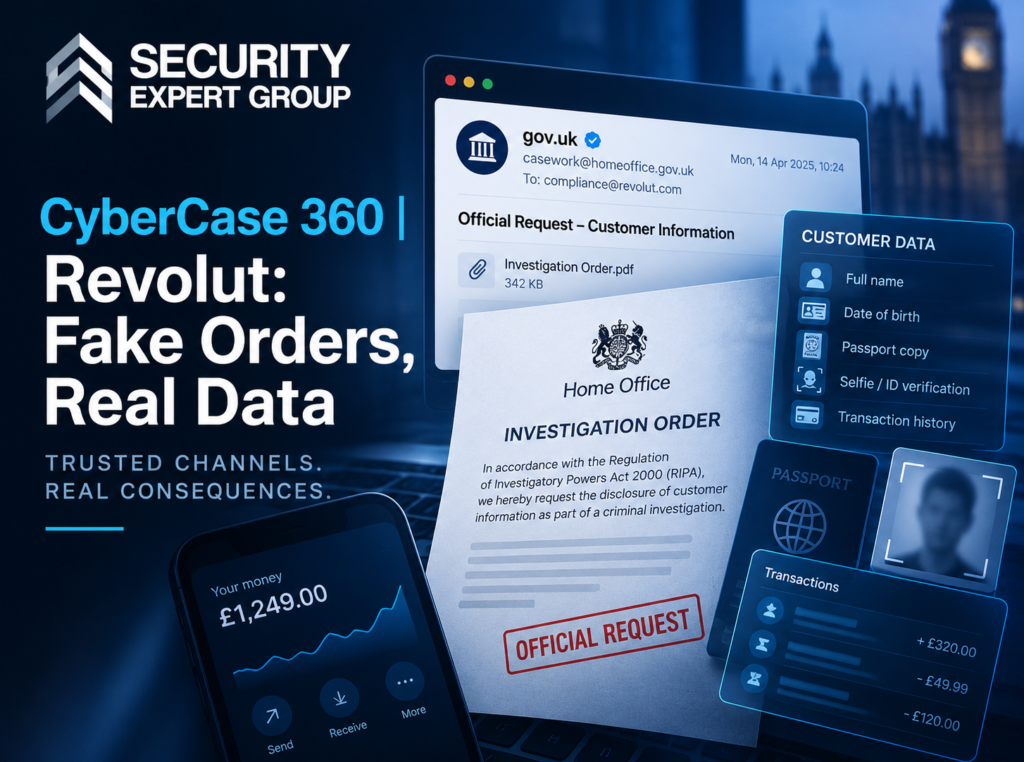
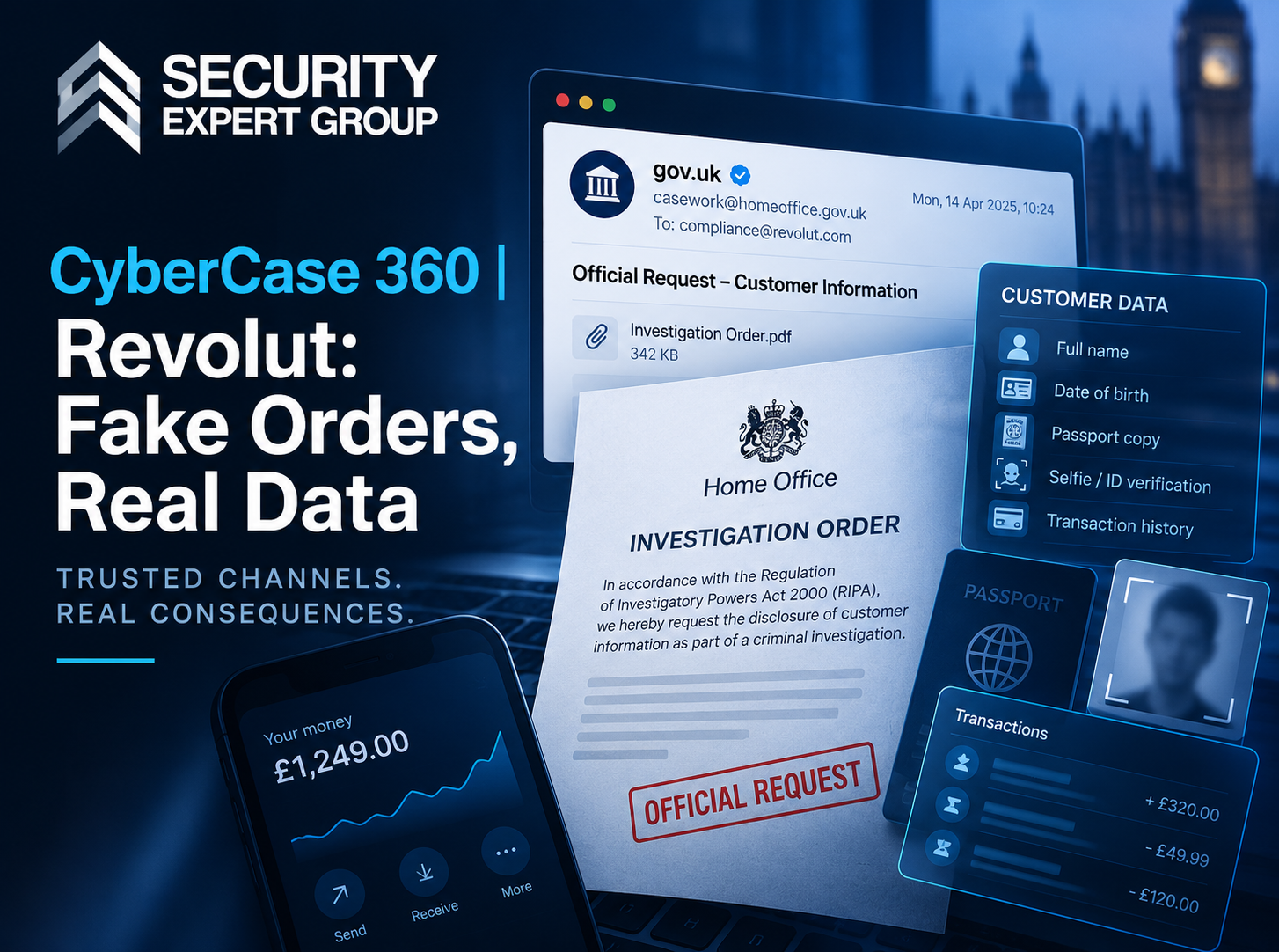
On 12 September 2026, Revolut confirmed what it called “a sophisticated external impersonation scam where an unauthorised third party utilised a legitimate government agency domain email to submit fraudulent requests for information” (Revolut statement via TechCrunch, 12 September 2026). Nothing at Revolut was exploited. No vulnerability was chained, no perimeter was breached, no employee clicked anything. The bank was asked for customer data through a channel it is legally obliged to honour — and it answered.
The requests arrived from an address on pec.interno.it, the Italian Ministry of the Interior’s domain on Italy’s Posta Elettronica Certificata system — a state-regulated certified-email service whose entire purpose is to make a message legally attributable to its sender. They were framed as European Investigation Orders, the cross-border evidence instrument created by Directive 2014/41/EU, and directed at Revolut Bank UAB, the group’s Lithuania-licensed banking entity (American Banker, 18 September 2026; Hudson Rock / InfoStealers, 15 September 2026).
The origin of the whole chain sits outside Revolut entirely, and outside the Italian ministry’s own attack surface as it is usually drawn. Hudson Rock’s Duel investigations team searched its cybercrime database and found approximately 300 compromised pec.interno.it webmail logins already sitting in infostealer logs harvested from previously infected machines. Its assessment was that the attacker almost certainly did not infect those employees personally — they bought or reused logs that were already on the market (Hudson Rock / InfoStealers, 15 September 2026). The credential that set Revolut’s disclosure posture for five months was a commodity.
Approximately 680 customers were affected, none of them in the United States. The disclosed data included identity and contact details, dates of birth, passport and driving-licence copies, facial verification selfies, IBANs, account statements and transaction histories including cryptocurrency activity (TechCrunch, 12 September 2026; American Banker, 18 September 2026; CyberInsider, 16 September 2026). A threat actor operating as “IAmNotAVillain” subsequently published samples — including what it presented as screenshots of the forged orders — and set a 24-hour ransom deadline running from Wednesday 16 September 2026 (Fintech Business Weekly, 20 September 2026).
This is the uncomfortable shape of the case. Revolut’s controls did not fail in the way controls usually fail. The bank performed the action it is required by law to perform, on the strength of a channel the European Union built specifically so that it could be trusted. The failure was in treating an authenticated envelope as an authenticated instruction — and in never once picking up the phone.
1. What Happened
| 1 | On 12 September 2026, Revolut confirmed “a sophisticated external impersonation scam where an unauthorised third party utilised a legitimate government agency domain email to submit fraudulent requests for information” (Revolut statement via TechCrunch, 12 September 2026). |
| 2 | The fraudulent requests were sent from an address on pec.interno.it — the Italian Ministry of the Interior’s domain on Italy’s Posta Elettronica Certificata (PEC) certified-email system — and were framed as European Investigation Orders, the cross-border evidence instrument under Directive 2014/41/EU, directed at Revolut Bank UAB in Lithuania (American Banker, 18 September 2026; Hudson Rock / InfoStealers, 15 September 2026). |
| 3 | Hudson Rock’s Duel investigations team identified approximately 300 compromised pec.interno.it webmail logins already present in infostealer logs within its cybercrime database, and assessed it “highly unlikely” that the attacker infected those employees directly — more probably purchasing or reusing existing logs (Hudson Rock / InfoStealers, 15 September 2026). |
| 4 | The campaign ran for approximately five months before public disclosure. Revolut states it fulfilled the requests “under the reasonable belief that it was an authentic government agency request” (SecurityWeek, 17 September 2026; Revolut statement via Fintech Business Weekly, 20 September 2026). |
| 5 | Approximately 680 customers were affected, none located in the United States. Disclosed data included identity and contact details, dates of birth, passport and driving-licence copies, facial verification selfies, IBANs, account statements and transaction histories including cryptocurrency activity (TechCrunch, 12 September 2026; American Banker, 18 September 2026; CyberInsider, 16 September 2026). |
| 6 | Revolut states it blocked the offending address after detection, alerted the relevant government agency, law enforcement, data protection authorities and financial regulators, and that internal systems and customer funds were not compromised (Revolut statement via TechCrunch, 12 September 2026, and via American Banker, 18 September 2026; CyberInsider, 16 September 2026). |
| 7 | A threat actor operating as “IAmNotAVillain” published sample identity documents, verification selfies, account statements and purported screenshots of the forged European Investigation Orders, and set a 24-hour ransom deadline running from Wednesday 16 September 2026 (Fintech Business Weekly, 20 September 2026). |
| 8 | Prosecutors in Reggio Calabria are reported to have opened an investigation on the Italian side (Fintech Business Weekly, 20 September 2026). |
2. Business Impact
| ✓ | [CONFIRMED] Approximately 680 Revolut customers affected, none located in the United States (American Banker, 18 September 2026; SecurityWeek, 17 September 2026). |
| ✓ | [CONFIRMED] Data disclosed included identity and contact details, dates of birth, passport and driving-licence copies, facial verification selfies, IBANs, account statements and transaction histories including cryptocurrency activity (TechCrunch, 12 September 2026; CyberInsider, 16 September 2026). |
| ✓ | [CONFIRMED] The fraudulent request campaign ran for approximately five months before public disclosure (SecurityWeek, 17 September 2026). |
| ✓ | [CONFIRMED] Approximately 300 compromised pec.interno.it webmail credentials were already present in infostealer logs in a single vendor’s cybercrime database — exposure that predates and is independent of this campaign (Hudson Rock / InfoStealers, 15 September 2026). |
| ✓ | [CONFIRMED] Revolut states internal systems and customer funds were not compromised, and that the offending sender address was blocked after detection (Revolut statement via TechCrunch, 12 September 2026; CyberInsider, 16 September 2026). |
| ✓ | [CONFIRMED] Attacker-published material includes identity documents, verification selfies, account statements and purported screenshots of the forged European Investigation Orders — the disclosed data is now partially public irrespective of any ransom outcome (Fintech Business Weekly, 20 September 2026). |
| ~ | [ESTIMATED] ATTACKER-CLAIMED — a ransom of 6,000 XMR (reported as approximately US$3 million) with a 24-hour deadline from Wednesday 16 September 2026 (Fintech Business Weekly, 20 September 2026; the same US$3 million figure reported by SecurityWeek, 17 September 2026). [UNRESOLVED] Earlier crypto-sector reporting described a demand of 10,000 Bitcoin (CryptoTimes, 15 September 2026); that figure is not corroborated by SecurityWeek, American Banker or Fintech Business Weekly and the discrepancy is unreconciled. No indication the ransom was paid. |
| ~ | [ESTIMATED] ATTACKER-CLAIMED — a six-month campaign duration (versus five months per Hudson Rock) and the theft of 147 GB from Italian law enforcement (threat actor via SecurityWeek, 17 September 2026). Unconfirmed by Revolut and by Italian authorities. |
| ~ | [ESTIMATED] ATTACKER-CLAIMED — targets were selected as cryptocurrency “whales” using blockchain analytics before the requests were issued (threat actor via Fintech Business Weekly, 20 September 2026). Unconfirmed, but consistent with the data categories Revolut confirmed were disclosed. |
| ~ | [ESTIMATED] Regulatory and financial exposure: no enforcement action, fine or supervisory finding had been announced at the time of writing. Scale of any regulatory penalty not publicly disclosed. |
3. Likely Root Cause
| 1 | Credential theft entirely outside Revolut’s perimeter. The initial access was a stolen webmail credential for the Italian Ministry of the Interior’s PEC domain, of which roughly 300 were already circulating in commodity infostealer logs.
Source: Hudson Rock / InfoStealers, 15 September 2026 |
| 2 | Trust anchored to the sending domain rather than to the requester. Revolut fulfilled the requests on the strength of the address they came from, under what it describes as “the reasonable belief that it was an authentic government agency request.”
Source: Revolut statement via Fintech Business Weekly, 20 September 2026 |
| 3 | The certified-email guarantee was over-read. PEC provides legal proof of transmission and sender-domain integrity; it does not assert that the human operating the mailbox is an authorised officer, and it offers no defence against an account takeover.
Assessed from American Banker, 18 September 2026 |
| 4 | No out-of-band verification step existed for compelled-disclosure requests. Nothing in the process required the receiving institution to confirm the order with the issuing authority through an independently obtained channel.
Assessed from Revolut’s own account of fulfilment; Revolut statement via Fintech Business Weekly, 20 September 2026 |
| 5 | No volumetric or anomaly review of the legal-request channel. Five months of sustained requests, concentrated on high-value accounts, produced no threshold alert or pattern review.
Assessed from SecurityWeek, 17 September 2026 |
| 6 | Attacker persistence inside the compromised mailbox: recovery addresses reportedly added, communications monitored, and outbound fraudulent messages deleted before the legitimate owner could see them — suppressing the one detection path that sat outside Revolut.
Source: CyberInsider, 16 September 2026. [UNRESOLVED] — attacker-side tradecraft not confirmed by Italian authorities. |
| 7 | Front-line handling reportedly coached the requester through correcting a malformed document rather than escalating it.
Source: Hudson Rock / InfoStealers, 15 September 2026; CyberInsider, 16 September 2026. [UNRESOLVED] — attacker-claimed and not confirmed by Revolut. |
4. Control Failures
| CF-1 | 🔗 Third Party Revolut’s disclosure posture was set by the credential hygiene of an external public authority it does not control, cannot audit and cannot contractually bind — a counterparty dependency that sits outside every conventional third-party risk register. |
| CF-2 | 📋 Process No mandatory out-of-band verification of inbound compelled-disclosure requests. The process had no step at which the receiving institution independently confirmed the order with the issuing authority before acting on it. |
| CF-3 | 🪪 Identity Authentication of the envelope was mistaken for authentication of the requester. The certified-email domain was treated as sufficient identity assurance; the European Investigation Order itself — its form, its issuing authority, its validation — was not independently verified. |
| CF-4 | ⚙️ Technology The legal-request channel was not instrumented. No rate thresholds, no anomaly detection and no structured audit trail existed over a path that disclosed passports, selfies and full transaction histories on request. |
| CF-5 | 👥 People Compelled-disclosure requests were handled without enforced segregation of duties, allowing customer-facing staff to engage with — and reportedly assist in correcting — a forged legal instrument instead of escalating it. [UNRESOLVED — attacker-claimed; see Root Cause.] |
5. Recommendations
5A — Organisational & Technical Controls
Audience: security, IT, legal and financial-crime teams.
| ↳ CF-1 | Subscribe every compelling authority’s domain to infostealer-log monitoring and treat a hit as a trust-suspension trigger
DORA Art. 5(2) — management-body responsibility for the ICT risk framework; ISO/IEC 27001:2022 Annex A 5.7 — threat intelligence Enumerate every domain entitled to compel disclosure from you — pec.interno.it and the equivalent PEC, gov and judicial domains in each jurisdiction where you hold a licence — and register them as monitored assets in an infostealer-log feed (Hudson Rock, SpyCloud, Flare class). Alert on any new log referencing those domains. On a hit, automatically downgrade that domain from single-channel trust to mandatory dual-channel confirmation until the issuing authority confirms remediation. This is the only control in this list that would have fired before the first fraudulent request was answered. |
| ↳ CF-2 | Make out-of-band callback mandatory on every compelled-disclosure request, with no exemption for certified channels
DORA Art. 5(1)–(2) and Art. 9(2); GDPR Art. 5(2) — accountability; ISO/IEC 27001:2022 Annex A 5.31 — legal, statutory, regulatory and contractual requirements Written procedure: the request is re-confirmed by telephone to a number obtained independently from the authority’s published official directory — never a number, address, reply-to or link contained in the request itself. Record the call reference, the name and protocol or badge number of the confirming officer, and the issuing prosecutor’s office, against the case record. The request remains unfulfilled until that confirmation is logged. The exemption clause is the whole failure here: PEC, eIDAS-qualified delivery and a .gov.it domain are exactly the signals that make people skip the call. |
| ↳ CF-3 | Validate the instrument, not the envelope — check the European Investigation Order against its own statutory form
Directive 2014/41/EU Art. 2(c), Art. 5 and Annex A, Art. 6(1)(a); Regulation (EU) 2023/1543 (e-Evidence) Art. 4 and Art. 9; ISO/IEC 27001:2022 Annex A 5.31 Require that every EIO arrives on the Annex A form of Directive 2014/41/EU, complete through Sections A to I; that Section H names an issuing authority competent under Art. 2(c); that, where the issuer is not a judge, court or public prosecutor, the order carries judicial validation under Art. 2(c)(ii); and that the proportionality and necessity conditions of Art. 6(1)(a) are stated rather than assumed. Auto-reject and escalate anything arriving as free-text email or as a PDF without the Annex A structure, and never accept a “corrected” resubmission of a rejected instrument. Under the e-Evidence Regulation, require the EPOC or EPOC-PR certificate and route orders to your designated establishment or legal representative under Art. 4 rather than to a support mailbox; Art. 9 gives you an explicit statutory route to seek clarification on a manifestly deficient order. |
| ↳ CF-4 | Instrument the legal-request channel as a privileged data path with its own detections
DORA Art. 9(2) and Art. 10(1) — protection, prevention and detection; NIS2 Art. 21(2)(b) — incident handling; NIST SP 800-53 Rev. 5 AU-6(1) and SI-4(2) Route all compelled-disclosure requests through a dedicated case-managed queue rather than a shared mailbox, and emit one structured audit event per request carrying requesting domain, instrument type, issuing authority, customer identifiers disclosed, data categories released and named approver. Build three detections on that stream: more than N requests from a single domain in a rolling 30 days; repeated requests naming customers above a defined balance or AUM percentile; and requests arriving outside the issuing authority’s normal working hours or deviating from its established language and formatting pattern. Review the queue weekly at DPO and financial-crime level. A five-month campaign concentrated on high-value accounts is a detection problem long before it is a verification problem. |
| ↳ CF-5 | Remove compelled-disclosure decisions from the front line and enforce two-person approval
NIS2 Art. 21(2)(g) — cyber hygiene and training; DORA Art. 13(6) — ICT security awareness and training; ISO/IEC 27001:2022 Annex A 5.3 — segregation of duties, Annex A 6.3 — awareness, education and training No customer-support tier may fulfil, acknowledge the substance of, or advise on a compelled-disclosure request. Hard-route a keyword set — European Investigation Order, ordine europeo d’indagine, EPOC, EPOC-PR, production order, letter rogatory, and the national equivalents in every licensed jurisdiction — to a named legal or financial-crime function, with two-person approval mandatory above a defined customer-count threshold. Train that function twice yearly on forged-instrument recognition using live red-team submissions rather than slideware. Deliver the user-facing rules in 5B below as a standing briefing to every team that touches inbound requests. |
5B — For the Customer-Facing and Operations Team
| 👥 For the Customer-Facing and Operations Team
Audience: everyone who touches an inbound request. Forward this page as-is. NIS2 Art. 21(2)(g) — basic cyber hygiene practices and cybersecurity training; ISO/IEC 27001:2022 Annex A 6.3 — information security awareness, education and training Maps to ↳ CF-5 1. A message from a government address is not proof it came from the government. An email can arrive from a genuine ministry domain simply because someone stole a real employee’s password. The address tells you which mailbox the message left from. It tells you nothing about who was sitting at the keyboard. 2. Never act on a legal request until you have called the authority back on a number you looked up yourself. Find the number on the authority’s own official website or published directory. Do not use any phone number, email address or link that appears inside the request — if the request is forged, so is the contact detail printed on it. A five-minute call is the entire control. 3. If the paperwork is wrong, that is a warning sign — not a customer-service problem. Do not explain how to fix a malformed legal document, and do not accept a corrected version once you have rejected one. Stop, write down what you saw, and hand it to the legal team. Real authorities have their own lawyers and do not need your help with their forms. 4. Pass every request for customer data to the named legal team, whatever it looks like. You are not the approver, and nothing about how official a request looks changes that. Forwarding it costs you a few minutes. Approving a forged one costs a customer their passport, their selfie and their entire transaction history. 5. Speak up if the same requester keeps coming back. One request looks routine. Twenty requests from the same office, all about wealthy customers, is a pattern — and you may be the only person in the building positioned to notice it. Say so, even if you are not sure. 6. Urgency is the oldest pressure tactic there is. “Emergency”, “immediate” and “active criminal investigation” are chosen to make you skip the verification step. A genuine authority that has waited weeks for a court to issue an order can wait five more minutes for your callback. |
6. Regulatory Relevance
| 1 | DORA — Regulation (EU) 2022/2554
Art. 5 (governance and ICT risk framework); Art. 9(2) and 9(4) (protection and prevention); Art. 10(1) (detection); Art. 17 (ICT-related incident management process); Art. 19 (reporting of major ICT-related incidents) Revolut Bank UAB is a credit institution licensed in Lithuania and therefore a financial entity in scope of DORA, which has applied since 17 January 2025. DORA is cited here because a licensed financial entity is squarely in scope — not as a default framework. Art. 17 requires a documented process for detecting, managing and notifying ICT-related incidents; a five-month undetected disclosure campaign is a direct challenge to it. [UNRESOLVED] Whether the incident crosses the Art. 19 major-incident thresholds on data losses and clients affected is not publicly determinable from the available reporting. |
| 2 | GDPR — Regulation (EU) 2016/679
Art. 5(1)(f) (integrity and confidentiality) and 5(2) (accountability); Art. 6(1)(c) read with Art. 23 (legal obligation as lawful basis); Art. 32(1)(b) and (d); Art. 33 (72-hour notification); Art. 34 (communication to data subjects) This is the sharpest regulatory point in the case. A disclosure made under a forged instrument has no Art. 6(1)(c) legal obligation behind it — the lawful basis collapses entirely, leaving unlawful processing rather than a breach caused by an intruder. Art. 5(2) then requires Revolut to demonstrate the verification it actually performed. [UNRESOLVED] Whether the facial verification selfies were processed as biometric data within Art. 9(1) — which would raise the threshold further — is not determinable from public reporting. |
| 3 | Directive 2014/41/EU — European Investigation Order in criminal matters
Art. 2(c) (issuing authority); Art. 5 and Annex A (form and required content); Art. 6(1)(a) (necessity and proportionality conditions); Art. 9 (recognition and execution); Art. 11 (grounds for non-recognition or non-execution) The instrument the attacker forged. It is not a free-form request: it prescribes a standard form, a competent issuing authority and, for non-judicial issuers, mandatory judicial validation — each of which is a checkable control that was available and was not exercised. Art. 11 gives an executing party explicit grounds to refuse. [KB UPDATE NEEDED] Directive 2014/41/EU — European Investigation Order in criminal matters; EU cross-border evidence-gathering instrument between participating Member States; directly relevant to any regulated entity that receives compelled-disclosure requests from EU judicial authorities. |
| 4 | Regulation (EU) 2023/1543 — e-Evidence (European Production and Preservation Orders)
Art. 4 (addressees, designated establishments and legal representatives); Art. 9 (execution of an EPOC and the addressee’s route to seek clarification); Art. 16 (review procedure in case of conflicting obligations) The successor regime for cross-border production orders, applying from 18 August 2026. It requires service providers to designate an establishment or legal representative to receive orders — which structurally removes the shared-mailbox failure mode seen here — and gives the addressee an explicit statutory route to seek clarification on a manifestly incomplete or erroneous order rather than simply complying. Every institution receiving EU compelled-disclosure requests should be re-papering its intake process against this regulation now. [KB UPDATE NEEDED] Regulation (EU) 2023/1543 — European Production and Preservation Orders for electronic evidence in criminal proceedings; binds service providers offering services in the EU; the governing instrument for compelled-disclosure intake design. |
| 5 | NIS2 — Directive (EU) 2022/2555 (Italian public-administration side)
Art. 21(2)(b) (incident handling); Art. 21(2)(g) (cyber hygiene and training); Art. 21(2)(i) (multi-factor authentication and secured communications); Art. 23 (reporting obligations); Art. 20 (management-body accountability) Engaged on the Italian side, not Revolut’s. The compromised mailbox sits inside a public-administration entity, and Art. 21(2)(i) — multi-factor authentication on communications systems — is the control whose absence made a commodity infostealer log sufficient for mailbox takeover. INTERSECTION FLAG: NIS2 Art. 4 makes DORA lex specialis for financial entities, so NIS2 incident reporting does not double-apply to Revolut itself. Two Member States and two supervisory stacks are engaged at once — Lithuania (Bank of Lithuania for DORA, the State Data Protection Inspectorate for GDPR) and Italy (ACN for NIS2, the Garante for the ministry’s own data-protection duties). |
| 6 | ISO/IEC 27001:2022
Annex A 5.3 (segregation of duties); A 5.7 (threat intelligence); A 5.31 (legal, statutory, regulatory and contractual requirements); A 5.34 (privacy and protection of PII); A 6.3 (awareness, education and training); A 8.16 (monitoring activities) The five control failures map one-to-one onto certifiable Annex A controls. A 5.31 is the underused one: it requires an organisation to identify and document how it meets legal requirements — which necessarily includes how it verifies that a claimed legal requirement is real. A 5.7 covers the infostealer-feed monitoring that would have caught the exposed credential before it was used. |
| 7 | NIST SP 800-53 Rev. 5
AU-6(1) (automated process integration for audit review); SI-4(2) (automated tools for real-time analysis); IA-5 (authenticator management); AC-5 (separation of duties) Provides the control-level vocabulary for instrumenting the legal-request path — the audit-review automation and real-time analysis that a five-month campaign should have tripped. Useful where a client’s control framework is NIST-aligned rather than ISO-certified. |
7. How SEG Can Help
| ↳ CF-1 / CF-3 | 💡 Third-Party Risk Assessment
SEG extends the third-party register beyond suppliers to counterparties that can compel you — regulators, judicial authorities, law-enforcement agencies — and stands up continuous infostealer-log monitoring against their domains, so an exposed credential at an authority becomes an alert on your side rather than a request you answer. |
| ↳ CF-2 / CF-5 | 💡 vCISO & GRC
SEG writes and embeds the compelled-disclosure procedure: mandatory out-of-band callback, independently sourced contact channels, two-person approval thresholds, Annex A form validation, and the DORA Art. 17 incident-management linkage — then evidences it for your supervisory authority. |
| ↳ CF-4 | 💡 SaaS Configuration Review
SEG reviews the case-management, ticketing and shared-mailbox tooling that legal requests actually arrive in, closing the logging, retention and access gaps that leave a privileged disclosure path with no usable audit trail. |
| ↳ CF-2 / CF-3 | 💡 Penetration Testing
SEG red-teams the disclosure channel directly — submitting realistic forged instruments from lookalike and, where authorised, genuine-appearing certified channels — to establish empirically whether your verification step holds under pressure, rather than assuming it does because it is written down. |
| ↳ CF-5 | 💡 Security Awareness Training
SEG delivers the 5B rules above as targeted training for customer-facing, operations, legal and financial-crime teams, built around forged-instrument recognition, escalation discipline, and resistance to manufactured urgency from apparently official sources. |
| 🎯 STRATEGIC SIGNAL
The industry has spent a decade hardening the front door and almost no time on the channels it is legally obliged to leave open. Compelled disclosure — European Investigation Orders, e-Evidence production orders, emergency data requests — is a high-privilege, low-friction data path that most regulated institutions run on institutional courtesy and a recognisable domain name. The lesson of this case is that the credential setting your exposure may belong to a government you cannot audit, bought for a few dollars in a log that was already on the market. Expect this technique to generalise quickly beyond fintech: the same channel exists at every telecommunications operator, cloud provider and exchange in Europe, and it is answered by people trained to be helpful. |
| 💬 SEG EXPERT VIEW — Dmytro Yershov, CISO
We want boards to sit with the most uncomfortable sentence in this case: Revolut did what the law told it to do. There was no unpatched system, no phishing click, no missed alert — the bank received what appeared to be a lawful order from a government mailbox and honoured it, for five months. That should reframe how risk committees think about their own exposure, because every institution we work with has a channel like this one, and almost none of them have ever tested it. Our second point is about ownership. The credential that opened this was not Revolut’s, was not its supplier’s, and sits in no third-party risk register we have ever reviewed — it belonged to a public authority with the legal right to compel disclosure and no contractual obligation to you whatsoever. You cannot audit that authority, you cannot demand its MFA posture, and you cannot make it rotate a password. What you can do is stop treating its domain as identity, monitor it against infostealer feeds, and require a callback on a number you looked up yourself before any customer data leaves the building. DORA makes the governance obligation explicit and places it with the management body, not with the SOC. The right question for the next board meeting is not whether you would have detected this — it is who in your organisation is currently allowed to answer a government request, and what, precisely, they are required to check before they do. |
📖 Sources
- TechCrunch — Revolut confirms customer data breach through fake government requests — September 12, 2026
- Hudson Rock / InfoStealers — Revolut Hackers Used Infostealers for Elaborate Social Engineering — September 15, 2026
- CyberInsider — Revolut hackers used infostealer to hijack Italian government emails — September 16, 2026
- SecurityWeek — Revolut Data Breach: 5 Months, 680 High-Profile Accounts, $3M Ransom — September 17, 2026
- American Banker — Revolut’s breach began with a stolen government password — September 18, 2026
- Fintech Business Weekly — “The Blood Will Be On Your Hands,” Revolut Hackers Warn — September 20, 2026