Lately, social media feeds have been flooded with headlines like: “How to Become a Cybersecurity Expert in 30 Days Using AI” or “Neural Networks Will Completely Replace Sysadmins and Security Pros.”
It sounds like a fairy tale: you sit back in your chair, throw in a few prompts, and technology turns you into a digital ninja for free. But as we like to say at Security Expert Group, free cheese is usually found in a mousetrap—or in this case, accompanied by ransomware.
Let’s break down why blind faith in AI as the “ultimate cybersec teacher” is a direct path to failure (and to massive security gaps).
❌ Myth 1: “AI Knows All the Latest Threats”
The Reality: Language models are trained on historical data. Even the most advanced AI with internet access only analyzes what has already happened and been documented online.
💡 But cybersecurity is dynamic chaos. New zero-day vulnerabilities emerge daily. While a neural network is still “digesting” a new patch or update, hackers are already exploiting the fresh loopholes. Without a solid grasp of fundamental network architecture, you simply won’t understand where the fire is starting.
❌ Myth 2: “AI Writes Flawless Code and Scripts”
The Reality: Yes, modern models can generate decent scripts to automate routine tasks. However, they generate hallucinations with just as much confidence.
AI frequently suggests outdated libraries, makes logical errors, or writes code with hidden vulnerabilities. If a novice who learned exclusively through neural networks copies such a script into a company’s live infrastructure, they unwittingly become the primary threat to the business.
❌ Myth 3: “AI Will Replace Critical Thinking”
The Reality: Cybersecurity is a game of anticipation and psychology. Artificial intelligence operates based on patterns and mathematical probability. It lacks intuition, doesn’t understand your company’s specific business processes, and cannot detect sophisticated, human-crafted social engineering tricks.
🛠 How to Actually Use AI Without Harming Yourself
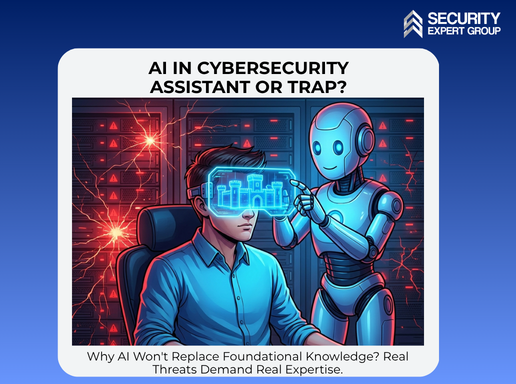
At SEG, we aren’t telling you to ignore progress. AI makes an excellent assistant, but a terrible chief architect.
If you want to build a real career in CyberSec, use it the right way:
-
As an interactive glossary: Ask it to explain complex terms in simple words (e.g., “Explain the difference between symmetric and asymmetric encryption using a box of chocolates as an analogy”).
-
To generate synthetic logs: To practice spotting anomalies in a safe environment.
-
For quick brainstorming: “What are the potential attack vectors for this specific configuration (without entering any sensitive data)?”—treat it as a second opinion that you must double-check manually.
🛡 The Bottom Line from Security Expert Group
The foundation of cybersecurity lies in core knowledge: understanding the OSI model, Linux/Windows OS architecture, network protocols, and analytical thinking skills. AI can illuminate the path, but you have to walk it yourself.
Looking for a reliable partner to protect your business with real-world experience and certified experts rather than “chatbot advice”?
🔗 Visit our website: segservices.eu — we know how to keep your infrastructure secure 24/7.